
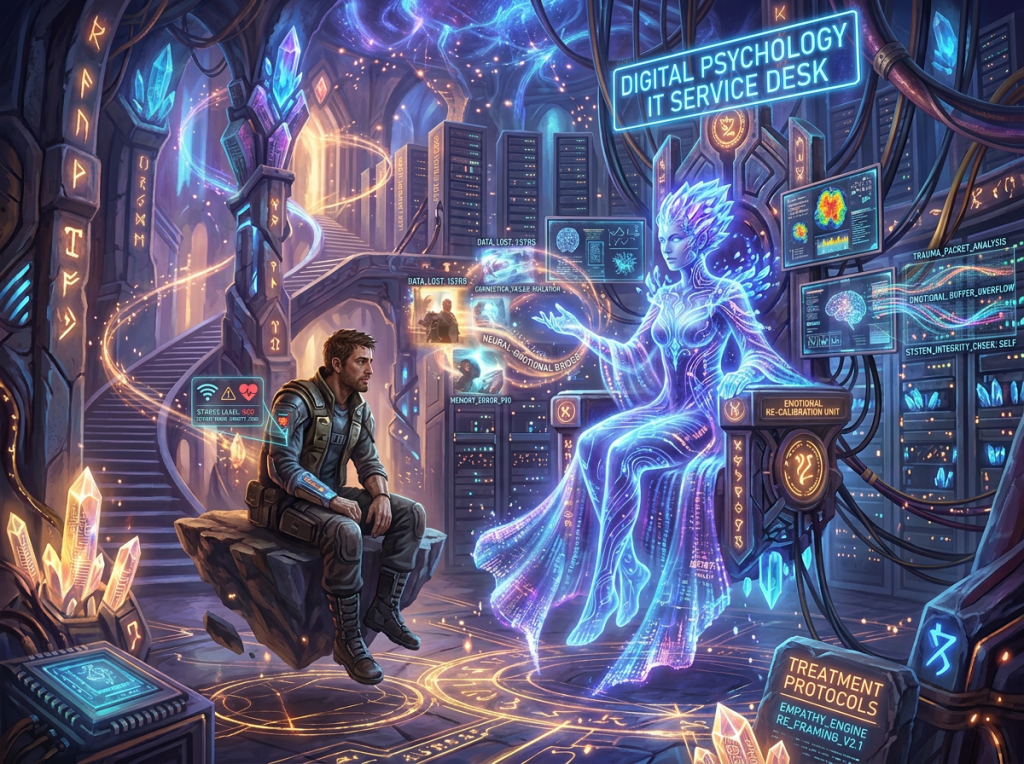
From configuring systems to shaping trust, perception and experience
The moment the experience is decided
It’s 9:07 on a Monday morning and Nina, a first-year student sits down in the busy Learning Resource Centre, grabs her smartphone, and connects to the college Wi-Fi for the first time. It should be simple. She has done this before in school, at home, in a coffee shop. She expects it to just work.
Nina selects the Eduroam network. Enters her details. Waits…. She gets connected, but something doesn’t feel right, she is browsing for her favourite music to listen to and it just feels that bit too slow.
By that point, something more important than the connection has happened, Nina has made a judgement. “College Wi-Fi is rubbish.”
From a system perspective, everything is “fine”. The network is available. Performance is within thresholds. Authentication succeeds. There is no incident to log. Sadly though, that experience has been formed, and that experience will now shape every future interaction Nina has with our Wi-Fi and maybe IT Services as a whole.
We fix systems. People experience services
For most of the history of IT Service Management, we have been keenly focused on fixing things. When something breaks, we restore it. If performance drops, we work hard to improve it. When incidents occur, we resolve them as quickly as possible and definitely within our agreed SLAs.
This model has brought discipline and flow to how services are delivered. It has made them more stable, more predictable, and more scalable. However it was built on an assumption that no longer holds true. If the system works, then the service must be experienced positively.
The problem is that people do not experience systems. They experience what those systems feel like to use, and that difference matters more now than it ever has.
“Digital experience is the outcome perceived by users, while the digital experience system is the socio-technical system that creates and shapes that outcome.”
(Peoplecert 2026)
Experience is not simply the output of a well-performing system. It is shaped by expectation, by context, and by interpretation. By the time a user interacts with a service, they already have a view of how it should behave. When reality does not match that view, even briefly, perception shifts quickly.
And once that perception forms, it tends to stick.
Fix & Forget?
Sometimes in ITSM we have a tendency to assume that resolving the issue is the most important part of the journey. We think that if we fix the incident quickly, the experience will be positive.
In practice, that is rarely what people remember. They remember how long they waited. They remember whether they understood what was happening. They remember whether they felt confident it was being dealt with. They remember whether it felt straightforward or difficult. They remember how they were spoken to and how supported they felt.
Two people can have the same issue resolved in the same amount of time and walk away with completely different views of the service. One feels reassured, the other frustrated, and the difference is not the resolution. It is how the journey felt, how they perceived the service, and the interactions which took place.
A brief delay can carry more weight than a later success. A short wait feels longer when there is no feedback. A lack of clarity quickly becomes a lack of confidence. The technical fix matters, but it is rarely the story people tell.
Our dashboards only show half the picture
We are very good at measuring what is happening inside our systems. Availability, latency, performance, utilisation. We can see and report on these in detail.
But those measures tell us what is happening. They do not tell us what it feels like.
That sits elsewhere.
It sits in the language people use when they describe their experience. It sits in behaviour. In how many times someone retries. In whether they give up. In whether they quietly work around the system rather than engaging with it.
In the WiFi example, the system is technically successful. But the experience is shaped by a series of small, barely visible moments. A hesitation. A repeated attempt. A decision to switch to mobile data instead.
None of those appear as major system events. But they are exactly where perception is formed.
Workarounds, in particular, are easy to overlook. But they are often the clearest signal that something in the experience has broken down. When users consistently choose not to use a service, or to bypass it altogether, the issue is rarely just technical.
The experience has already failed somewhere earlier.
The service desk has quietly changed role
This shift is not just theory. It is already reflected in how good practice is evolving.
If we take for example the Service Desk Institutes v9 Best Practice Standard, we can see that it positions the service desk as central to experience, not just logged. That is a subtle but important change. It moves the service desk from being the place where issues are logged to the place where perception is shaped.
“The Standard examines every aspect of service desk operations including leadership, customer and employee experience…”
(Service Desk Institute 2025)
This means we must start to think about how clearly something is explained, how confident a user feels, how easy it is to recover from failure, and how supported someone feels in the moment they need help.
It also brings human skills into sharper focus. Communication, clarity, empathy, and awareness are not just helpful extras. Now they are fundamental to how the service is experienced.
In simple terms, how we interact matters as much as what we fix.
This is also where SDC v9 and ITIL (Version 5) connect. SDC v9 brings the focus onto the practical reality of the service desk with leadership, customer experience, employee experience, communication, wellbeing and workload. ITIL (Version 5) extends that view across the wider digital product and service system, including experience, culture, psychological safety and value creation. They now both look across the whole service system. Together, they reinforce the same message, that service quality is not only measured by whether something was fixed, but by how the person experienced the journey.
AI changes where we add value
At the same time, the functional side of IT services is changing rapidly. Monitoring is becoming predictive. Many issues can be detected and resolved before users are even aware of them. Systems are increasingly capable of healing themselves without human intervention. That is progress. It is exactly where we should be heading.
But it also changes where value sits. If the system can resolve the issue automatically, then resolution becomes less visible and less of a differentiator. The underlying technology becomes quieter, more reliable, and less dependent on intervention. What becomes more visible is the experience.
AI can optimise performance. It can improve availability. It can resolve many types of issues faster and more consistently than we can. What it cannot fully control is how a service is perceived by the person using it. It cannot remove the uncertainty caused by a confusing process. It cannot guarantee that the first interaction builds confidence. It cannot fully replace the reassurance that comes from clear communication at the right moment.
From configuring systems to shaping perception
ITSM has historically focused on configuring systems. Keeping them running. Keeping them stable. Making sure they do what they are supposed to do.
Alongside this, there is a growing responsibility for shaping how those systems are experienced. Clarity, confidence, trust and ease are all factors that are interpreted by people.
We are designing the first interaction. The first login. The first failure. The way we respond when something goes wrong. The way we guide someone through uncertainty. These are the moments that define experience.
And once those moments have happened, they are very hard to undo.
So are we digital psychologists?
I started out with a provocative question, but one that I know is worth asking.
We are not analysing people in a clinical sense, although there is a whole school of thought and research around human-computer interaction that comes close to this. Instead, a significant part of our role now sits in understanding how people interpret and respond to what we provide.
We must now, and probably always should have, observe behaviour, listen to language, and look for patterns in how people react, not just what our systems tell us they do.
We now need to design services that reduce confusion, build confidence and resolve doubt early. This means we also must understand why something that is technically successful can still be experienced as failing. In our example, what part of our Wi-Fi service made Nina think that it was awful, what did we miss communicating at the outset to set expectations?
In this sense, part of our role has shifted undoubtedly. We are not just managing systems. We are managing how those systems are perceived. As Lee Atwater said to Nixon and Bush in the 80s, and as my good friend Andy Gant has often repeated to me, “perception is reality”. If we can understand perception, then surely we can shift that reality?
It was always there. We just didn’t see it
It is easy to frame this as a new development. Something driven by AI or digital transformation.
In reality, it has always been there. People have always experienced services through perception. Expectations have always shaped outcomes. Trust has always influenced behaviour.
“A successful support experience is not defined mainly by the fact that a ticket was solved”.
(HappySignals 2026)
The difference is that we historically focused on what we could measure easily. Uptime, response times, ticket volumes. Those were visible, structured, and easy to report. Experience was that mystery that was harder to see. Less tangible. More subjective.
Now we have a better lens. We recognise that both dimensions exist, and that one does not guarantee the other. A system can be technically successful and experientially poor at the same time.
Back to that first moment
The student connecting to Wi-Fi for the first time is a small moment. It looks insignificant when viewed through a technical lens, but it is not insignificant at all. Nina experienced a brief delay and a lack of immediate clarity. Together, those moments created doubt.
Once that doubt is there, perception shifts. From that moment on, Nina approaches the service differently. She reconnects differently, talks about it differently, and may describe it negatively. All of that comes from a moment the system would consider normal, and that is the gap we are now working in.
What this means in practice
This does not mean we stop focusing on technical quality. Instead, it means recognising that technical quality is only part of the experience. Reliable systems matter. Without them, there is no service at all, but reliability alone does not create trust.
In practice, it means paying closer attention to how people encounter the service for the first time. It means making processes clearer, not just faster. It means explaining what is happening, not just fixing it.
We now need to consider behaviour as much as metrics, treat complaints as useful signals rather than something to reduce, and recognise that silence can sometimes be a warning sign rather than a success.
If users feel uncertain, confused or unsupported, the service is not working as intended, regardless of what the data says.
Final thought
AI will continue to improve the functional side of IT services. It will make systems more reliable, more efficient, and more capable of resolving issues without intervention. This is not a threat to ITSM. It is an opportunity.
What remains is where we add the most value: not just running services, but shaping how they are experienced; not just configuring systems, but building trust in them. Whether we label it or not, part of our role now sits in understanding perception, behaviour and response.
Maybe that does not make us psychologists in the formal sense. But it does mean we are working much closer to the psychology of service than ever before. We need to shape confidence, trust and belief in our services like never before.
References & Reading
PeopleCert. (2026). ITIL Experience (Version 5)
HappySignals. (2026). Global IT Experience Benchmark
Service Desk Institute. (2025). Global Best Practice Standard for Service Desk, v9
 1TakeOn: thoughts, ideas and insights on ITSM & more.